Overseas vs Malaysia Specialist Fees:
Overseas vs Malaysia Specialist Fees: Patient Burden Explain. Many ordinary people in Malaysia feel unhappy about Malaysia specialist fees:, They ask a common question: Do doctors and specialists in other countries follow standard charges when patients use medical cards or insurance? Or is it different from Malaysia, where some people say specialists charge very high fees just as they like? This article explains the situation in simple language that everyone can understand. We look at the rules in Malaysia, compare them with other countries, talk about examples like daily doctor visits in hospital and medical reports, and see what the Malaysian Medical Council (MMC) can do.
Malaysia Specialist Fees:
How Doctor Fees Work in Malaysia.
In private hospitals and clinics in Malaysia, there are rules about what doctors can charge. These rules come from a law called the Private Healthcare Facilities and Services Act. The government sets maximum fees for doctors’ professional services. This includes consultation fees and fees for medical procedures. For specialists, the first consultation fee has a maximum limit. Recent updates put the range around RM80 to RM235 for a first visit, depending on how complex the case is. Follow-up visits have lower maximums, often around RM40 to RM105. These are the highest amounts doctors are allowed to charge for their own professional work.
However, the total hospital bill is often much higher. Why? Because hospital fees for the room, nursing care, medicines, laboratory tests, and equipment use are not controlled by the same strict maximum prices. Hospitals can set those charges more freely. When patients use a medical card (private insurance or takaful), the insurance company pays part of the bill according to its own rules. The patient may still have to pay the difference, called a gap or co-payment.
This is why some patients feel the charges are too high or unfair. The doctor’s professional fee may stay within the legal limit, but the overall bill grows because of other costs. Insurance may cover only a set amount for the doctor’s visit. If the hospital or doctor bills higher, the patient pays the extra.
Why Total Bills Still Feel Expensive
Common Examples That Worry Patients
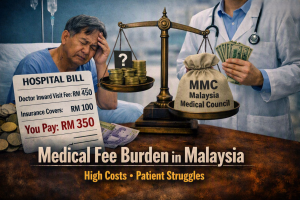
Patient burden by Malaysia healthcare
Doctor inward visit fee Malaysia
Take the example of an inpatient (someone staying in the hospital). A patient might hear that the doctor’s daily visit fee should be around RM100. But the bill shows RM450. The patient then has to pay the extra RM350 out of pocket. This can happen if the insurance covers only up to a certain amount, or if facility charges are added, or if the visit is listed as more complex.
Medical reports also cause complaints. People say charges range from RM100 to RM350 or even higher. In reality, the fee depends on the type of report. A simple insurance form may cost less (around RM80 to RM150 in many places). A detailed specialist report that needs careful review of records and a written opinion can cost more, sometimes RM200 to RM500 or higher in private hospitals. Public hospitals usually charge lower fixed rates, such as RM40 for a basic report or RM80 to RM200 for specialist ones for Malaysian citizens.
These fees are not completely free for the specialist to decide. Guidelines exist, and the amount should match the work involved. Still, patients often feel the prices jump without clear reason, especially when they need the report for insurance claims, EPF, or legal matters.
Countries with Fixed Fee Schedules
What Happens Overseas?
In many other countries, the system works differently, especially when patients have insurance or a medical card equivalent. In countries like France, Germany, Japan, and parts of Europe, the government or health insurance funds negotiate fixed fee schedules with doctors’ associations. Specialists must charge according to these official rates for patients covered by the national or social insurance. Doctors cannot simply pick any high number. If they want to charge more (called balance billing), it is limited or not allowed for basic coverage. The patient knows in advance what the co-payment will be. In Australia, Medicare has a standard benefits schedule. Specialists can charge higher fees, but the government rebate is fixed. Patients pay the gap. Many specialists choose to bulk-bill (accept only the standard fee) for certain patients.
In the United Kingdom’s public National Health Service, care is mostly free at the point of use for residents. Private specialists set their own fees, but insurance companies often have agreed rates. In the United States, fees can be very high and vary a lot. Insurance companies negotiate contracted rates with doctors. Out-of-network specialists can charge much more, and patients face large extra bills.
So yes, many overseas systems have clearer standards for insured patients. The doctor cannot freely decide any amount when the patient uses official insurance coverage. The fees are standardised or negotiated. This protects ordinary people from sudden large extra charges. Of course, private care outside the insurance system can still be expensive everywhere.
Can the Malaysian Medical Council Stop Overcharging?
The Malaysian Medical Council (MMC) is the body that registers doctors and looks after professional behaviour and ethics. It has a Code of Professional Conduct. This code says doctors should avoid improper or unreasonable fees. Doctors should give patients clear information about charges before treatment when possible.
However, the main power to control the actual fee amounts lies with the Ministry of Health through the Private Healthcare Facilities and Services Act. The Ministry’s Private Medical Practice Control Section (often called CKAPS) checks if professional fees stay within the legal maximums. They can investigate complaints, issue warnings, fine clinics or hospitals, or take stronger action if doctors or facilities break the fee schedule rules.
The MMC can act if a doctor’s charging behaviour is unethical, such as charging without proper explanation, pressuring patients, or other misconduct. It can investigate complaints about professional conduct and take disciplinary steps, including suspension in serious cases. But MMC does not set the fee numbers or do routine random checks of every bill. Enforcement of the price ceilings mainly comes from the Ministry of Health.
Random checking of all specialists would be difficult because there are thousands of private doctors. The system relies a lot on patients making complaints. When people report overcharging of professional fees, the authorities can investigate. Facility fees that are not regulated are harder to control under current law. The government has talked about possible changes to regulate more types of charges in the future.
What Patients Can Do to Protect Themselves
What Can Patients Do?
Patients are not helpless. Here are practical steps:
- Ask for an estimate of costs before treatment or admission whenever possible.
- Request an itemised bill that shows the doctor’s professional fee separately from hospital charges.
- Check with your insurance company what amount they will cover for the specialist visit or report.
- If you believe the professional fee is above the legal maximum, complain to the hospital first, then to the Ministry of Health’s private healthcare control unit.
- For medical reports, ask in advance what type of report you need and the exact fee.
- Keep all documents and receipts.
Public hospitals remain a much cheaper option for many Malaysians, with heavily subsidized fees.
Conclusion: Fair Fees and Better Protection for Patients
Looking at the Bigger Picture
The feeling that specialists charge “at their whim and fancy” comes mainly from the gap between regulated professional fees and unregulated hospital costs, plus insurance limits. Overseas, many systems reduce this problem by having stronger standard rates for insured care.
Private hospital charges Malaysia
In Malaysia, the law already sets maximums for what specialists can charge for their own work. Exceeding those maximums is not allowed. Medical report fees should also be reasonable for the work done. The MMC helps maintain ethical standards, while the Ministry of Health enforces the fee rules.
For ordinary people, the best protection is knowledge, asking questions early, using insurance wisely, and reporting clear cases of overcharging of professional fees. Clearer rules on more parts of the bill and better public information would help reduce the burden on patients who struggle with unexpected extra costs.
Healthcare costs are rising in many countries. Understanding the rules helps patients protect themselves and push for fairer systems. Everyone deserves medical care that is both good quality and reasonably priced, without sudden large extra bills that cause real hardship.
Fast