Malaysia vs Overseas: Are Specialist Fees Fair to Medical Card Patients?
Malaysia Medical Card: Fair Specialist Fees
Specialist fee comparison
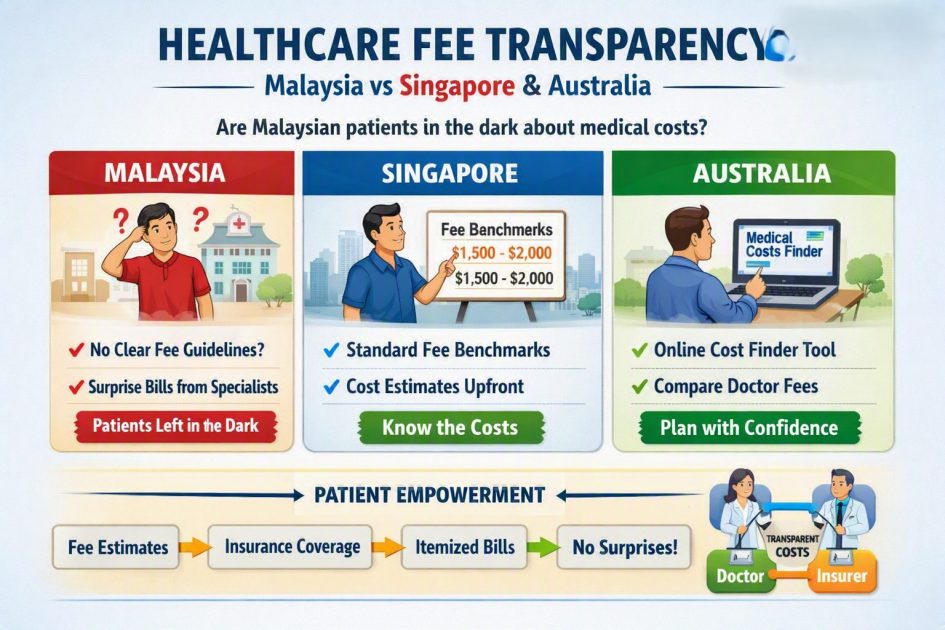
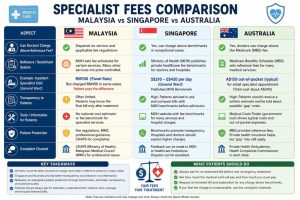
The question of specialist fees becomes clearer when Malaysia is compared with other countries.
It is important not to claim that foreign doctors always charge less than Malaysian specialists. That would not be accurate. Medical treatment costs vary greatly according to the country, hospital, doctor’s experience, complexity of the case and type of treatment.
The more important question is different:
How does each country protect patients from unexpected specialist bills?
This is where Malaysia can learn from countries such as Singapore and Australia.
In some countries, doctors are still allowed to charge more than a government or insurance reference fee. However, patients are given better information about the expected cost, the reference fee and the amount they may have to pay themselves.
That is particularly important for a patient using a medical card.
Singapore: A Useful Example for Malaysia
Singapore healthcare benchmarks
Singapore is probably the most useful country for Malaysia to compare with because it is geographically close, has a large private healthcare sector and also has private medical insurance.
Singapore’s Ministry of Health publishes private healthcare fee benchmarks for doctors and hospitals.
These benchmarks are recommended charges. They are intended to show patients and insurers what would generally be a reasonable range for routine and typical cases.
The Singapore Ministry of Health currently publishes benchmarks for:
- surgeon fees;
- anesthetists fees;
- hospital fees;
- doctors’ inpatient attendance fees;
- and numerous procedures and medical conditions.
The Ministry specifically tells patients to ask their doctor and hospital how the expected fees compare with the MOH benchmarks before admission.
This is a major difference in approach.
The system does not simply say:
“The specialist has charged this amount, so the patient must pay it.”
Instead, the patient can ask:
“What is the normal benchmark for this service?”
That gives the patient a reference point.
Singapore’s Inpatient Specialist Fees
The comparison becomes particularly interesting when we look at inpatient attendance.
Singapore’s current Ministry of Health benchmark for a doctor visiting a patient in a general ward during office hours is S$210 to S$420 per day.
For a High Dependency Unit, the benchmark is S$260 to S$530 per day.
For lower-intensity ICU cases, it is S$320 to S$630 per day.
These are current recommended ranges published by the Singapore Ministry of Health.
This does not mean every Singapore specialist must charge exactly within the range.
The Singapore system recognises that some cases are more complicated than others.
The Ministry says fees can exceed the benchmarks in exceptional cases where additional risk, time and effort are required. However, doctors and hospitals should inform patients in advance, where possible, if their fees are expected to exceed the benchmarks.
This is an important principle.
A higher fee can be justified, but the patient should know why.
That is a much better approach than leaving a patient to discover the extra bill after treatment.
Singapore’s System Is Not Perfect — But It Provides Transparency
It would be wrong to say that Singapore completely controls doctors’ fees.
The Singapore fee benchmarks are recommendations rather than a universal compulsory price ceiling.
However, the Ministry of Health says the benchmarks have helped improve price transparency and discipline in private healthcare charging. It reported that close to 90% of doctors were charging within recommended surgeon fee benchmarks when it assessed the impact of the system.
This is an important lesson for Malaysia.
Malaysia does not necessarily need to tell every specialist:
“You can only charge RMX.”
Instead, Malaysia could establish a strong national benchmark system and require doctors and private hospitals to explain significant charges above the benchmark.
That would preserve professional freedom while protecting patients.
Australia: Doctors Can Charge Above the Government Fee
Australia medical costs finder
Australia provides an even more interesting comparison.
Australia has the Medicare Benefits Schedule, commonly known as the MBS.
The government sets a schedule fee for medical services.
However, Australian doctors are generally allowed to charge more than the MBS fee. The difference can become an out-of-pocket payment for the patient.
Therefore, Australia also has the problem of a “gap”.
The Australian Government explains that when a private patient is treated in hospital, Medicare generally pays 75% of the MBS fee for eligible medical services and private health insurance may pay the remaining 25%, depending on the policy.
However, a doctor can charge more than the MBS fee, leaving the patient with an additional gap.
So Australia proves an important point:
Having a medical insurance system does not automatically mean that the patient will never have to pay extra.
The difference is in how much information the patient receives.
Australia Provides a Medical Costs Finder
Australia has introduced a government Medical Costs Finder to help patients understand medical specialist costs.
Patients can search for a procedure or service and see information about typical costs.
The system can show typical costs, specialist fees and information about possible out-of-pocket expenses.
For example, the Australian Government’s Medical Costs Finder reports that for an initial specialist appointment in a private setting, among patients who had such an appointment in 2023–24, 73% had an out-of-pocket cost. Those patients typically paid A$159, while Medicare paid A$81, producing a typical total fee of approximately A$240.
The important point is not whether A$159 is cheap or expensive.
The important point is that the government provides a way for patients to understand what other patients typically pay.
Malaysia could consider developing something similar.
Australia Also Warns Patients About the “Gap”
The Australian Government advises patients to ask doctors for a written estimate before treatment.
Patients are also advised to ask for the relevant MBS item numbers and to find out whether other doctors, such as an anaesthetist or assistant surgeon, will be involved.
This is important because several doctors can generate separate bills during one hospital admission.
In other words, the Australian system recognises that a patient needs to know:
Who will bill me?
How much will each person charge?
How much will my insurance pay?
How much will I personally have to pay?
This is exactly the kind of information that Malaysian medical-card patients need.
What About the Malaysian Example of RM100 Versus RM450?
Let us return to the example raised by many patients.
Suppose a patient is admitted to a private hospital.
The patient believes that the specialist’s inpatient visit should cost around RM100.
Instead, the specialist charges RM450.
The medical card provider recognises only RM100.
The patient is then told to pay the remaining RM350.
The first question should not automatically be:
“Why is the specialist charging RM450?”
The first question should be:
“What exactly is the RM450 charge?”
Is it:
- an ordinary inpatient attendance;
- an additional specialist consultation;
- an after-hours visit;
- a procedure;
- a special examination;
- a consultation involving another specialist;
- or another professional service?
Without knowing the exact service and applicable fee schedule, nobody can responsibly say that RM450 is illegal.
However, if it is an ordinary service subject to a regulated fee schedule and the charge is above the permitted amount, that becomes a much more serious matter.
If it is not subject to a fixed fee, the patient should still be given a reasonable explanation for the charge.
This is where random audits could help.
What Malaysia Could Learn From Singapore
Malaysia could establish a system combining the best features of the Singapore approach.
For example, the Ministry of Health could publish a national Private Specialist Fee Benchmark.
The benchmark could show:
| Service | Suggested Fee Range | Explanation |
|---|---|---|
| Specialist consultation | RM___–RM___ | Normal consultation |
| Inpatient attendance | RM___–RM___ | Normal daily ward review |
| After-hours attendance | RM___–RM___ | Emergency/additional visit |
| Medical report | RM___–RM___ | Depends on complexity |
| Specialist procedure | RM___–RM___ | According to procedure |
| Complex specialist report | RM___–RM___ | Detailed report |
The actual figures would need to be determined by the Ministry after consulting specialists, hospitals, insurers and patient groups.
The purpose should not be to force every doctor to charge the same amount.
The purpose should be to give the public a reasonable reference point.
What Should Happen If a Specialist Charges Above the Benchmark?
This is where Malaysia can improve further.
If a specialist charges above the benchmark, the hospital could be required to record a reason such as:
“Complex case requiring additional specialist time.”
Or:
“Emergency attendance outside normal hours.”
Or:
“Additional procedure performed.”
The patient should receive this information.
If the case is genuinely complicated, most reasonable patients will understand that additional professional work deserves additional payment.
But if the charge is significantly above the benchmark and there is no clear explanation, it should trigger further review.
This could be done through random audits.
Random Audits Would Protect Honest Specialists Too
Some doctors may object to government monitoring because they believe it will interfere with professional independence.
But a properly designed audit system should not punish doctors simply because they charge more.
Instead, it should identify unusual patterns.
For example, regulators could randomly select private hospital bills and examine whether:
- the service billed was actually provided;
- the correct fee category was used;
- the charge complied with applicable regulations;
- the patient was given an estimate;
- the patient was informed of any significant additional cost;
- the medical report fee was properly explained;
- the final bill differed substantially from the estimate;
- and the patient was given an itemised invoice.
A doctor who can explain a higher fee should have nothing to fear.
On the other hand, repeated unexplained excessive charges should receive attention.
This would also protect honest specialists from being unfairly associated with doctors who may abuse the system.
Medical Reports Need the Same Transparency
Private healthcare transparency
The same principle should apply to medical reports.
A patient may be told:
“The report costs RM350.”
The patient should be able to ask:
“Why RM350?”
Is it a simple medical report?
Is it a detailed specialist report?
Does it require reviewing years of medical records?
Does it require additional investigation?
Does the report require the specialist to provide an expert opinion?
These differences can justify different prices.
The problem occurs when the patient receives no explanation.
The government could therefore establish standard categories for medical reports, such as:
Basic report
Specialist summary
Detailed specialist report
Complex expert report
Each category could have a recommended fee range.
This would make the system easier for ordinary Malaysians to understand.
Medical Cards Should Not Become a Reason for Higher Charges
Medical card patient protection
There is another issue that deserves public discussion.
A specialist should not assume that because a patient has a medical card, the patient can afford any amount.
The medical card does not mean the patient has unlimited money.
A medical card is an insurance arrangement.
The patient has paid premiums, often for many years, in exchange for financial protection.
If the insurer has a panel rate of RM100 but the specialist charges RM450, the patient may be trapped between two parties.
The insurer says:
“We only cover RM100.”
The specialist says:
“My fee is RM450.”
The patient is left with RM350.
That is precisely why there must be greater transparency before treatment.
The patient should know about the possible gap before, rather than after, receiving treatment whenever circumstances allow.
Malaysia Should Not Simply Copy Overseas Countries
There is no need for Malaysia to copy Singapore or Australia completely.
Both countries have their own healthcare systems and problems.
Singapore’s private healthcare costs can be high.
Australia also has significant out-of-pocket costs.
The lesson is not:
“Foreign doctors are cheaper.”
The lesson is:
“Patients need better information and stronger protection against unexpected costs.”
Singapore provides fee benchmarks.
Australia provides the Medical Costs Finder and information about gaps.
Malaysia can develop its own system suited to Malaysian conditions.
A Fair System Should Protect Three Parties
A good system should protect three groups:
1. The Patient
The patient should receive treatment without being surprised by unexplained charges.
2. The Doctor
The specialist should receive fair payment for professional knowledge, time, skill and responsibility.
3. The Insurer
The insurance company should have clear and predictable information about what it is expected to pay.
At present, patients can sometimes become caught in the middle of disagreements between doctors, hospitals and insurers.
That is not fair.
What Should a Malaysian Patient Do When Faced With a Large Bill?
Before signing or accepting non-emergency treatment, ask for:
1. The specialist’s professional fee.
2. The hospital’s charges.
3. The estimated total bill.
4. The amount expected to be paid by the medical card.
5. The estimated patient shortfall.
6. The reason for any charge above the applicable fee schedule or benchmark.
7. An itemised bill after treatment.
If the amount is disputed, ask the hospital to explain the charge in writing.
Then contact the medical-card provider and ask why the amount was not covered.
If the issue concerns a private healthcare facility or service, the patient can consider making a complaint to the Ministry of Health’s CKAPS.
If the concern relates to professional conduct by a registered doctor, a complaint may also be made to the Malaysian Medical Council.
Patients should keep all documents, bills, receipts, estimates, letters and correspondence.
The Real Question for Malaysia
Specialist fee comparison
The real question is not:
“Should Malaysian specialists be allowed to earn good fees?”
Of course they should.
Specialists spend many years studying and training. They carry enormous responsibility for their patients.
The real question is:
“Should a patient be allowed to know in advance what the specialist is likely to charge and how much the medical card will pay?”
The answer should be yes.
And if the charge is far above the normal range, there should be a clear reason.
Singapore has demonstrated that fee benchmarks can improve transparency and discipline without necessarily imposing one compulsory price on every doctor. Its Ministry of Health has reported that the benchmarks have helped moderate fee increases.
Australia has demonstrated another useful approach by providing patients with a government tool to examine typical specialist costs and understand possible out-of-pocket expenses.
Malaysia should consider developing both ideas.
A Simple Proposal for Malaysia
The Government could introduce a Malaysia Private Healthcare Fee Transparency System with five basic rules:
Rule 1 — Publish benchmarks.
Publish recommended ranges for specialist consultations, inpatient attendance, procedures and medical reports.
Rule 2 — Give estimates.
Before non-emergency treatment, patients should receive an estimated specialist and hospital bill.
Rule 3 — Explain exceptional charges.
If the expected specialist fee is substantially above the benchmark, the reason should be explained to the patient.
Rule 4 — Conduct random audits.
CKAPS and other relevant regulators should randomly examine private hospital bills to identify unusual charging patterns.
Rule 5 — Create one easy complaint channel.
Patients should be able to submit the bill, medical-card statement and supporting documents online and have the complaint directed to the correct authority.
This would make the system much easier for ordinary Malaysians.
Conclusion
Malaysia does not have to choose between doctors being fairly paid and patients being protected.
We can have both.
Singapore shows that a country can publish private healthcare fee benchmarks and encourage doctors and hospitals to explain charges above the normal range.
Australia shows that a country can provide patients with information about typical specialist fees and possible insurance gaps, even though doctors may still charge above government schedule fees.
Malaysia should learn from these systems.
The objective should not be to accuse all specialists of overcharging.
It should be to prevent unexplained, unreasonable and unexpected charges.
A patient who is lying in a hospital bed should not have to become a financial expert, insurance expert and lawyer just to understand a medical bill.
When a specialist charges RM450 instead of RM100, the patient deserves a clear explanation.
When a medical report costs RM350, the patient deserves to know why.
When the medical card pays only part of the bill, the patient deserves to know the reason before treatment whenever possible.
And when a charge appears unreasonable, the patient deserves a simple and effective way to complain.
Fair treatment should include fair billing.
That should be the standard Malaysia aims for.